
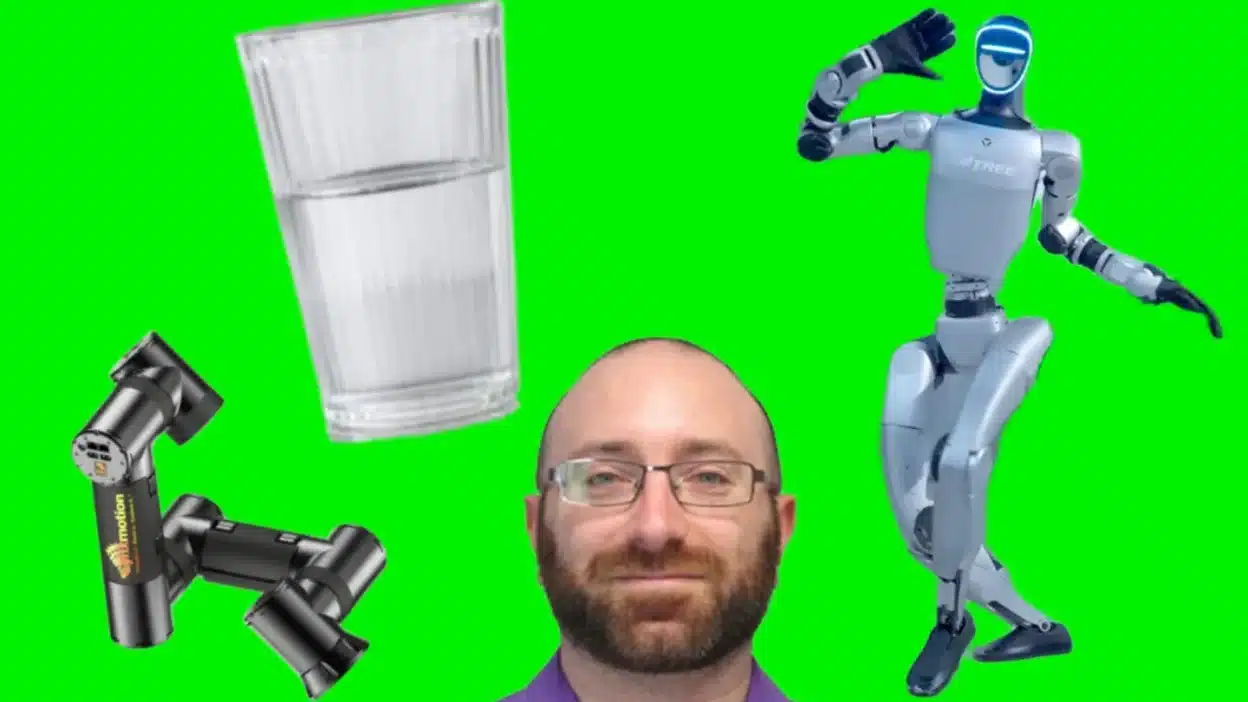
Summary: With over 20 years of experience, veteran roboticist Coleman Benson offers a practical look at the humanoid robotics industry. In this exclusive profile, we explore the reality of robots today, why putting them in our homes is harder than it looks, and the possibilities of machines made from organic, living materials.
Key Takeaways:
- Veteran roboticist Coleman Benson views humanoids as practical tools rather than the superhuman machines often seen in videos
- Homes remain the most difficult environment for robots because of unpredictability
- The industry is slowly starting to pivot from traditional metal and plastic toward “living robots” built from biological materials
Are robots good or bad?
It’s a question I was eager to ask Coleman Benson, Senior Product Specialist & Integration Services Manager at RobotShop, Canada’s largest robotics retailer and developer.
Having spent 18 years with the company and over two decades as a roboticist, Coleman has had a front-row seat to the evolution of modern machines.
“That’s actually a very interesting question. I don’t think I’ve thought about it either way,” he says.
“I’ve just thought of it sort of like you would imagine a better television, for example. We eventually go from a large television to a flat screen to … it’s a natural progression. So I didn’t think of it in terms of good or bad, to be honest. I just think of them as tools.”
That answer marked the first moment I felt myself reevaluating how I’ve been thinking about robots.
As someone who’s by no means a techie, I know I’m coming at this topic from a very different place than Coleman. Which is exactly why I wanted to talk to him.
Before joining RobotShop, which also manufactures its own robots and kits, he built a 12-degree-of-freedom quadruped robot as part of a university project, and he watched Honda’s ASIMO humanoid make its debut in the early 2000s.
But unlike many of us who are both fascinated and slightly freaked out by robots, Coleman doesn’t see spectacle. He sees engineering.
So what else does he see when he looks at the robots we have now and what’s coming next?
That question led to an hour-and-a-half Zoom conversation that ranged from the realities of today’s humanoid robots to the possibility of future “living robots” made from organic materials.
The “Glass of Water” Philosophy: A Realist’s Take on Robotics

It doesn’t take long to realize that Coleman has a way of talking about robots that strips away a lot of the drama many of us tend to pile onto them.
At one point, he gives me another version of his answer that puts a spin on a classic analogy.
“The glass has water in it,” he says. “It’s not half full, it’s not half empty. It just has water. I don’t try to be a pessimist. I don’t try to be an optimist. I try to be a realist.”
It’s a wonderfully cogent way to illustrate how he approaches robotics.
He isn’t trying to sell me on a utopian future where humanoids perfectly unload the dishwasher and become beloved members of the family. He also isn’t trying to scare me with p-doom warnings about robots taking over the world.
He comes at all of this from a deeply practical place, which is quite reassuring.
The Humanoid Reality Check: What 20+ Years in the Industry Has Taught Him

When I bring up humanoid robots, for example, Coleman quickly brings the discussion back down to earth.
“The humanoid robots we have in 2026 are incredibly versatile mechanically, but the technology itself isn’t revolutionary. It’s still standard mechanics and computer electronics,” he explains.
“The holy grail of getting a robot physically capable is pretty much there. It can be more capable than us. For example, I can’t do a standing side flip,” he laughs.
“But what it’s really coming down to is battery power because it still consumes a lot of current to do anything. It also comes down to intelligence. Not just artificial intelligence, but machine vision.”
His perspective is shaped not just by observing robots, but by working on them as well. RobotShop is best known for selling robots and components, but the company also develops some of its own platforms, giving Coleman and his colleagues a closer look at how these machines actually come together.
As he continues, “If you want a robot to pick up an apple from a table, it has to recognize what an apple is, recognize the term ‘pick up,’ understand how far away it is, and know how to actually flex the fingers in order to pick it up properly without squeezing too hard or dropping it.”
Only then can it attempt the simple things humans do every day without thinking. “The processing power is still limited. It can only do so much internally.”
Which is why, he tells me, a big part of his job at RobotShop involves “managing customers’ expectations.”
Buying a Robot Is Not the Same as Using One
As the conversation continues, we talk more about humanoid robots for sale.
Coleman smiles when I bring up the idea of robots being “out of the box” ready.
“Anyone can buy one. You could buy one right now if you have a credit card that works. The real question is: could anybody actually use it?”
To explain what he means, he reaches for a comparison that instantly makes sense.
“It’s like buying a Formula 1 car,” he says. “You can purchase one if you have the money. But could you really make use of it?”
Probably not.
Most humanoid robots today still require programming, technical expertise, and careful setup before they can do anything useful. They aren’t the plug-and-play household helpers many of us imagine when we see a slick demo online.
Still, Coleman isn’t the average consumer on the street. He has plenty of technical expertise and robotics know-how, so I have to ask: Would he want a humanoid robot in his own home?
“It depends on what their capabilities are, but my current thought process is more tending towards no,” he says.
“The sheer weight of a 180-centimeter-tall humanoid going up and down stairs and tripping can do damage. If it brushes up against a door, it’s going to chip part of the door.”
He pauses, then laughs. “I don’t necessarily need it. That’s where I’m coming from. I can load my dishwasher one dish at a time.”
Why the Home Is the Hardest Environment for Robots

Even as humanoid robots become more capable, the truth is that homes are very different from the controlled factory environments where we see most robot demonstrations.
Coleman gives a surprisingly simple example from RobotShop’s own showroom.
“We have two carpets where it’s not perfectly flat. It’s gray on gray and there’s a little bump in it. The robot might not see that, so its foot might get caught and it could topple over.”
Materials can create their own problems.
“A lot of these sensors can’t see glass,” he says. “So the robot might just try to walk through it.”
Then there’s the fact that homes contain something factories rarely do: chaos.
“Let’s say you have a young child. They run up suddenly, and now the robot is off balance and crashes.”
He pauses.
“You need to know what it does rather than just let it loose in a house.”
When he lays it out like that, the gap between impressive demo videos and everyday reality becomes much easier to understand.
Beyond Humanoids: Why the Best Robots Won’t Always Look Like Us
For all the attention humanoid robots get, Coleman isn’t fully convinced having robots mimicking the human form will be the long-term winner.
“There’s no doubt in my mind that someday we could have humanoid robots being confused as real people based on their proportions, fluidity of motion, comprehension, and level of interaction.”
Even so, he comes back to the same practical point. “I think whatever works will be the way to go,” he says.
“You could have something with wheels and legs. Or one big arm and a smaller arm for manipulation.”
Once you move away from the idea that robots have to look like people, the possibilities open up.
“If something is cute and fuzzy, or looks like a character or an animal, people tend to anthropomorphize it,” he says. “But something more mechanical that has a couple of extra arms, or that’s sort of toasteresque, might actually make more sense.”
That idea is already playing out in real products like Jennie the robot puppy, designed to comfort people with dementia and others who may benefit from therapeutic companionship.
The same broader point also shows up in industrial robotics. In my interview with Kateryna Portmann of ANYbotics, she shared how four-legged robots are handling dangerous inspections in places too risky for humans.
As Coleman sees it, “it might not be a humanoid robot that wins in the next 20 years. It might be something more hybrid.”
Solving Real Problems: Where Robots Provide the Most Value

After all this talk of robots, I’m curious where Coleman sees them making the most meaningful difference.
I mention elder care, and he responds quickly.
“You just nailed it,” he says. “The most beneficial to humanity is going to be elderly care.”
In many places around the world, populations are getting older while birth rates are falling. In some countries, the numbers are already at record lows.
“If you look at Japan, the birth rate is around 1.2,” he explains. “To maintain a stable population, you need something closer to 2.3.”
In other words, fewer workers will be available to support a growing number of older adults who need help. That’s one reason Coleman sees robots eventually stepping in to support a very real human need.
Biological & Living Robots: Where the Future of Robotics Gets Weird
Even before we spoke on Zoom, Coleman had already pointed me toward one of the stranger possibilities in robotics.
It seems a bit surprising coming from someone who has spent over two decades working with traditional metal and silicon, but for Coleman, it’s just a part of natural progression.
“The one twist on robotics that I’ve been following, though it’s still in its infancy, has fields like biorobotics, bioforms, cybernetics, and similar.”
In plain English, the idea is “to get away from using materials like metals, plastics, and composites and move toward organic materials for structures and actuation.”
That could take a lot of forms, from fungal mycelia grown into mechanical shapes to cloned or created “cells” being used for decision-making.
Where that path might ultimately lead, he says, is “living robots,” or at least machines with a much larger organic element to them.
To me, it’s a wild idea that sounds a lot more like sci-fi than the kinds of robots we see now. But by this point in our conversation, hearing it from an industry realist, it doesn’t feel entirely out of bounds.
Back to the Glass of Water: Maintaining a Practical Outlook on an Automated Future
By the end of our conversation, I realize I’m starting to think about robots more like Coleman does: as tools rather than mysterious machines that could take over the world one day.
As he had so succinctly summed it up before:
“The glass has water in it. It’s not half full, it’s not half empty. It just has water.”
That same practical mindset shapes how he looks at the future of robotics.
“The issues we face in the near future are likely less technological and more societal.”
Translation: the bigger questions may not be whether we can build smarter machines, but how we choose to use them.
“The biggest benefit,” he says, “is going to be the tasks that nobody wants to do, or the tasks there simply aren’t enough people to do.”
If that’s where robotics is headed, that doesn’t sound bad to me. In fact, it sounds pretty good.