Summary: Industrial robots like ANYmal are quietly transforming how dangerous work gets done. In this interview, ANYbotics Senior Product Manager and IFR Top 10 Women in Robotics honoree Kateryna Portmann explains how these machines improve safety, build trust through performance, and reshape everyday life behind the scenes — often without people ever realizing it.
Key Takeaways:
- Industrial robots can make dangerous inspections safer by operating in environments too risky for humans
- While trust in robots can be slow, it builds through consistent performance, clear data, and reliability
- Diverse perspectives help create robots grounded in real-world human needs
When many of us think about robots, we tend to focus on the technology: how fast, smart, and advanced it is.
But for Kateryna Portmann — Senior Product Manager at ANYbotics and one of the International Federation of Robotics’ 2025 Top 10 Women in Robotics — it’s much more personal than that.
“I often think about robotics not just as technology, but as a responsibility,” she says.
“I was born about 100 km from Chernobyl, and that has deeply shaped how I see the role of robots in our world. There are still many environments today where people work in extreme conditions — no clean air, intense heat, constant risk — where a single mistake can cost lives.”
Portmann believes robots are a way to change that.
“They don’t get tired, they don’t breathe toxic gases, and they can detect dangers humans can’t see.”
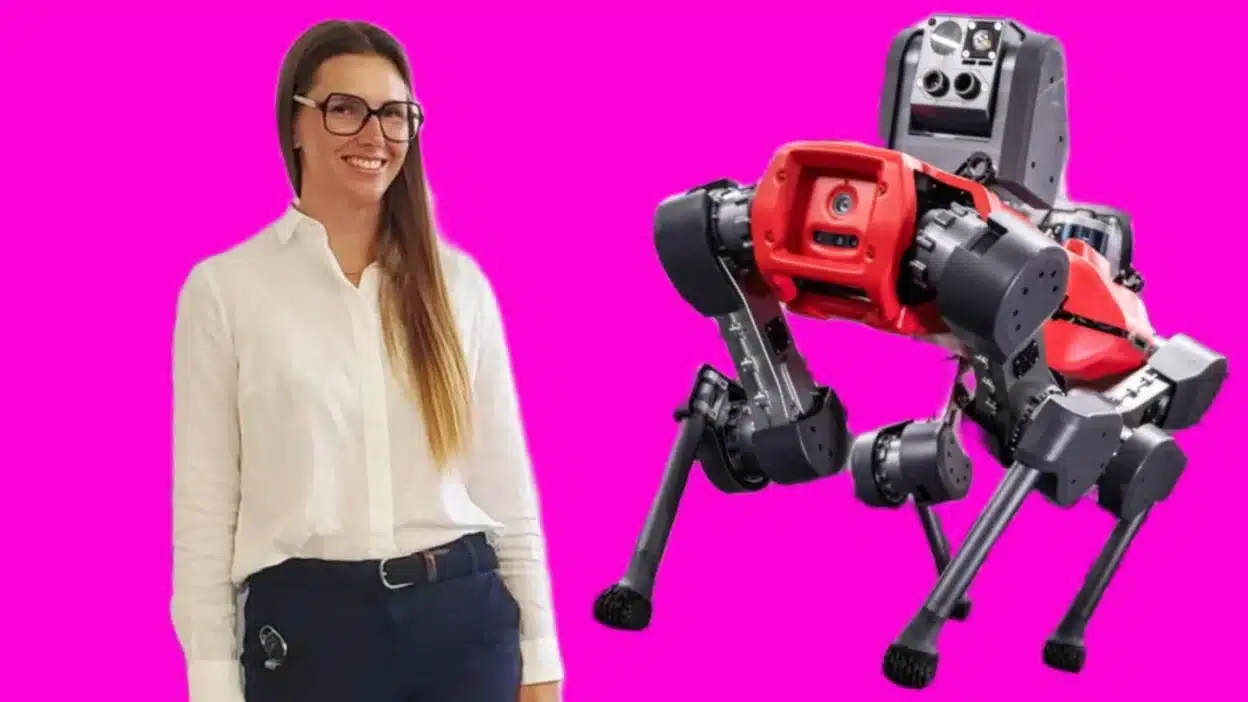
In her role, she works at the intersection of technology and real-world impact with the company’s four-legged autonomous robot, ANYmal.
Most of us will never come face to face with a machine that’s designed to go where humans can’t. But that doesn’t mean we won’t feel the effects of what it makes possible.
“Even if most people never interact directly with robots like ANYmal, they will benefit from them through safer infrastructure, fewer accidents, and more reliable systems,” she says.
“That’s the real impact: improving lives quietly, in the background.”
I was already interested in hearing from someone working in industrial robotics, since it’s a field that can feel foreign to many of us. But Portmann’s perspective helped clarify what’s really at stake.
While I’ve spent time looking at what humans can do that robots can’t, this conversation shifted the focus to the other side: how robots can handle risks we shouldn’t have to take.
In my Q&A with her, we talked about what builds trust in robots, why diverse perspectives matter, and how these machines are already reshaping everyday life behind the scenes.
Why Robotics Needs Empathy, Not Just Engineering

It’s easy to assume that robotics is purely a technical field with engineers building machines. But Portmann’s path shows that shaping robotics doesn’t require a traditional engineering background.
“Not being an engineer has actually become one of my biggest strengths as a Product Manager.”
Her role is about what’s technically possible and what actually works in the real world.
“Empathy helps me understand the people working in the field. Creativity helps challenge assumptions. Communication ensures alignment across very different teams.”
That perspective didn’t come out of nowhere.
From an early age growing up in Ukraine, Portmann was drawn to understanding how things worked, especially robots.
She remembers wanting robot toys while others were given dolls or teddy bears. Even when she didn’t get high-tech toys, she found ways to explore on her own.
Today, that same mindset shows up in how she approaches her work.
As she says, “When different perspectives come together, we don’t just build what is technically possible — we build what is truly useful and impactful.”
How Performance Builds Human Trust
One of the main questions I had for Portmann was why so many people hesitate to trust robots.
In industrial settings, confidence seems to build in a much more practical way.
“Trust is built through consistency and clarity,” she says.
“When robots deliver reliable data, reduce downtime, and make operations more predictable, people begin to rely on them. That’s when trust forms.”
Real-World Reliability: The Offshore Example

She points to one example that shows how this happens in real life.
On a remote offshore wind platform, ANYmal was deployed to carry out routine inspections in a dangerous environment that’s costly and complex to access.
“Traditionally, human workers would need to travel there by boat or helicopter to perform routine inspections in harsh conditions: high winds, corrosion, confined spaces, electrical risk.”
With ANYmal, that completely changed.
“The robot autonomously performed inspections over extended periods, meaning humans didn’t need to be physically present unless absolutely necessary.”
What stood out to Portmann wasn’t just how the quadruped reduced real physical risk, but how it eliminated mental and emotional uncertainty.
“Most of the time, the robot confirms that everything is working perfectly. I’ve come to realize how valuable that is.”
She offers a comparison that makes this idea immediately clear:
“It’s a bit like when my nanny sends me updates during the day about my 7-month-old daughter — not only when she’s crying, but just to show that she’s happy, safe, and everything is fine. That constant reassurance has real emotional and practical value.”
The same dynamic applies to industrial environments.
“Instead of only reacting when something breaks, operators now have continuous confirmation that systems are running as expected. And when something does go wrong, the robot has already captured the data needed to act precisely.”
Why Hesitation Still Exists
That kind of reliability builds trust in risky settings. But hesitation doesn’t disappear entirely, especially when robots begin to enter more personal, everyday environments.
“People want to understand what data is being collected and how systems work. With quadrupeds or humanoids, there’s also an emotional layer because they feel unfamiliar. That’s why transparency and clear value are so important.”
As Portmann puts it, “trust comes when people feel informed and in control.”
Are Robots Teammates or Tools?

As robots and physical AI play a bigger role in the real world, one question keeps coming up: should we think of them as tools, teammates, or something to be wary of?
Portmann’s answer is clear.
“Robots are, first and foremost, tools — very powerful ones.”
“They act as safety enablers, taking on dangerous, repetitive, or physically demanding tasks and extending human capabilities. In some environments, they may feel like teammates, but humans remain in control.”
It’s an important distinction at a time when so much public anxiety around robots is tied to the fear that they’ll take over, replace people, or become something harder to control.
“A thoughtful, responsible approach matters, but fear doesn’t help us move forward.”
Why Diverse Perspectives Create Better Technology
While I was researching Portmann, it became obvious that she cares deeply about making sure robotics reflects a wider range of perspectives.
“Diversity fundamentally improves what we build,” she says.
“When more women and different perspectives are involved, the questions we ask change, the problems we prioritize shift, and the solutions become more inclusive and relevant.”
As robotics continues to shape everyday life, Portmann believes that breadth of perspective matters more than ever.
“It’s critical that it reflects a wide range of experiences, not just a narrow slice.”
That perspective is echoed by other leaders in the field. In my interview with Stefania Ferrero of Comau, another International Federation of Robotics Women in Robotics honoree, she also shared how diversity shapes the future of automation.
It Truly Takes a Village

Portmann has also spoken openly about another part of life in robotics: balancing a demanding career with family life.
“Today, I have two children and work full-time, and it would not be possible without the strong support system of my husband, my parents, and carers. It truly takes a village.”
Motherhood has also changed how she works. “Becoming a mother made me more focused and intentional. I use my time and energy very differently now.”
For Portmann, having both a career and a personal life is possible, but only with the right support and a willingness to keep adjusting.
The Impact We Don’t Always See
Most of us won’t encounter robots like ANYmal in our day-to-day lives.
We won’t see them inspecting industrial sites or detecting hazards in places too dangerous for humans. But that doesn’t mean those robots aren’t shaping the world around us.
They’re helping prevent accidents. They’re making infrastructure more reliable. They’re reducing the number of people exposed to high-risk environments.
In many cases, they’re doing it quietly, without fanfare.
Maybe that’s part of what makes this side of robotics so important. Even when we don’t see it, we still live with its impact.
If you’re interested in robots you’ll likely be seeing in everyday life, check out my interview with veteran roboticist Coleman Benson on the shifting reality of humanoid robots.