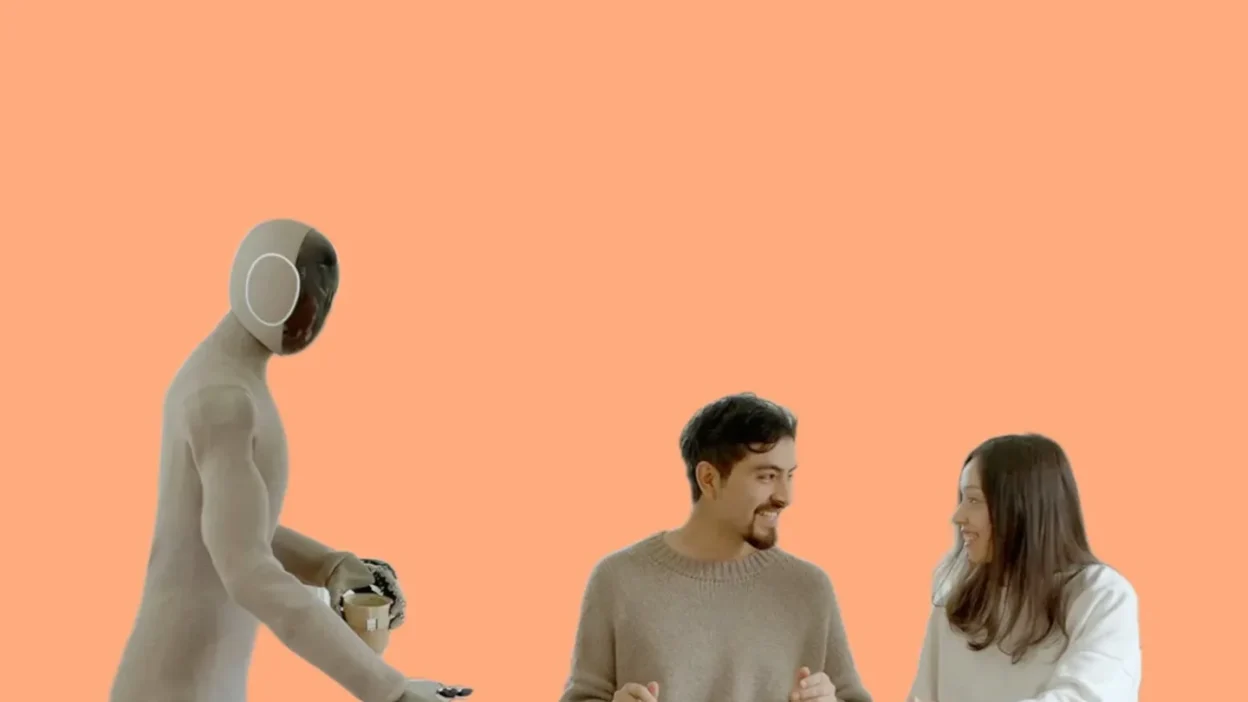
Summary: What can humans do that robots can’t? Humans still outperform robots in unstructured, real-world situations. From navigating physical chaos to interpreting social nuance and making complex judgment calls, we apply knowledge across unfamiliar environments in ways machines still struggle to match.
Key Takeaways:
- Humans outperform robots in unpredictable environments where conditions constantly change and require real-time adaptation
- People understand context, nuance, and unspoken cues that robots can simulate but not fully interpret
- Humans apply knowledge across different situations without needing task-specific training or retraining
When people ask what humans can do that robots can’t, the answers are usually pretty predictable: empathy, creativity, emotional intelligence.
All true. But also a little abstract.
The more useful way to look at it is what happens in the real world, especially in situations that are messy and unpredictable, or don’t come with clear instructions.
Because even though robots are great in controlled environments, humans still have the edge in places where things don’t go according to plan. We can understand the unspoken context of a conversation and pivot during a crisis, all while taking the family dog out for a walk and making sure he doesn’t bark at the neighbors.
There’s even a name for this: Moravec’s Paradox. It’s the idea that tasks we find effortless are still incredibly difficult for machines.
These basic “sensorimotor” skills — like moving through a cluttered room or spotting a friend in a crowd — are actually the most difficult for machines to replicate. While a robot can “see” with cameras, it lacks the split-second perception required to navigate the physical world as fluidly as we do.
Here, we’re focusing on real-world situations where people still outperform robots.
5 Key Areas Where Humans Outperform Robots

When you break it down, the fundamental gap between human intuition and robotic logic becomes clearest in a few specific scenarios. Primarily, it’s where humans can adapt, interpret, and respond in ways robots still struggle with.
Here are some of the clearest examples of what humans can do and robots can’t.
1. Navigate Unstructured Environments
One of the biggest challenges for robots is the real world.
Most robots are designed to operate in structured environments where things are controlled and predictable. Factory floors are clean, layouts are fixed, and tasks are clearly defined. That’s where robots thrive.
But step outside of that, and things get complicated fast.
A cluttered home, a busy restaurant, or a construction site all introduce constant changes. Objects aren’t where they’re supposed to be. People move unpredictably. Surfaces aren’t consistent. Even something as simple as a rug that isn’t perfectly flat can throw things off.
During our interview with roboticist Coleman Benson of RobotShop, he offered an example from the company’s own showroom:
“We have two carpets where it’s not perfectly flat. It’s gray on gray and there’s a little bump in it. The robot might not see that, so its foot might get caught and it could topple over.”
This highlights a major robotic hurdle: while we see a “bump” and adjust, a robot struggles with the visual perception of low-contrast surfaces.
Instead of having spatial awareness like we do, they rely on sensors, maps, and models of the world that can break down when conditions change or when something unexpected shows up.
This is a big part of why robots perform best in controlled settings and why navigating everyday environments remains one of the hardest problems in robotics.
2. Understand Context and Social Nuance
Another area where humans still outperform robots is in understanding context, especially the kind that isn’t explicitly stated.
Robots can process language, recognize patterns, and even respond in ways that sound natural. But they don’t truly understand human intent in the same way people do. A lot of our communication happens “between the lines.”
We pick up on tone, body language, timing, and subtle cues that shape how something is said and what it actually means. The same sentence can come across as serious, sarcastic, or joking depending on context, and most people can tell the difference almost instantly.
You see this in everyday moments that require emotional labor, from healthcare and caregiving to high-pressure customer service or conflict resolution.
Humans use active listening to adjust their approach based on the specific person they’re talking to, which is a level of emotional intelligence that remains difficult for AI to replicate.
While robots rely on patterns and probabilities to simulate understanding, they don’t actually “get” the subtext. This makes social nuance one of the hardest human traits to mirror in a machine.
3. Make Judgment Calls Without Clear Rules
Humans also have the advantage over robots when there’s no checklist to follow and the ambiguity is high.
A lot of real-world decisions involve compromise. You may have to choose between speed and safety, fairness and efficiency, or one person’s needs and another’s. In those moments, the right call usually depends on judgment, not just execution.
People do this all the time. A nurse may have to decide which patient needs attention first. A manager might have to calm down a conflict before it spreads. A parent may have to make a split-second decision with imperfect information. These aren’t situations where every variable is known in advance.
That’s where robots fall short. They work best when the goal is clear and the rules are defined. As recent research into human agency shows, when priorities clash or situations involve ethical trade-offs, human judgment is still much harder to replace.
4. Generalize Across Situations

Unlike robots, humans can apply what we know in new or unfamiliar situations.
We don’t need to be trained on every specific scenario to figure something out. If you know how to use a hammer, you can usually transfer or “generalize” that knowledge to a mallet or a crowbar. You’re performing what experts call “zero-shot” learning — solving a new problem correctly the very first time.
Robots don’t work that way. Most systems are trained or programmed for specific tasks in specific environments. If you change the setup even slightly, performance can drop off quickly.
A robot designed for one type of task can’t easily switch to a completely different one without retraining. This is why humanoid robots still struggle with basic household tasks and the unstructured chaos of a family home.
For example, a robot might be a pro at loading a specific dishwasher in a lab, but it gets confused when it has to navigate a room full of scattered toys or a toddler darting across its path.
People, on the other hand, are constantly generalizing. We take what we’ve learned in one scenario and use it in another, often without even realizing it.
5. Build Trust and Human Connection

Finally, humans have a clear advantage over robots when it comes to building trust.
More than just being friendly, biological empathy is what sets us apart. Trust is shaped by shared experience, body language, and the inner sense that the other person actually understands what’s going on.
You see this in situations like caregiving, teaching, or even everyday interactions where reassurance is necessary. A nurse calming a patient, an instructor reading the room, or someone handling a difficult conversation all rely on more than just the right words.
Robots can simulate emotion, recognize faces, and generate language that sounds supportive. But as research shows, there’s a major difference between a programmed response and genuine connection.
In situations where trust really matters, people still look to other people.
What Robots Can Still Do Better Than Humans
While humans outperform robots in many real-world situations, there are still areas where robots have the advantage.
They can operate in extreme environments, perform highly precise movements, process large amounts of data quickly, and carry out repetitive tasks with accuracy. These are the kinds of structured conditions where machines tend to perform best.
If you’re curious where robots go beyond human limits, we break that down in more detail in our guide to what robots can do that humans cannot.
FAQ
Will robots eventually be able to do everything humans can?
Robots will continue to improve, but tasks involving human relationships, ethical judgment, and navigating “unstructured” physical chaos remain the most difficult to replicate at a human level.
Why are simple tasks still hard for robots?
Things we find effortless — like walking across a bumpy rug — are actually complex perception challenges. Robots struggle with these tasks because they require constant, real-time adaptation to physical conditions that aren’t perfectly clean or predictable.
Do robots still need humans to operate effectively?
Yes. Many advanced systems rely on a “human-in-the-loop” approach. This often involves teleoperation, where a person remotely assists a robot with decision-making or physical maneuvers that go beyond its programming.
What makes humans different from robots?
The biggest differentiator is generalization. Humans can take a lesson learned in one context and apply it to a totally new situation. Robots are currently strongest in “narrow” environments with clearly defined rules.
Where Humans Still Lead
Humans aren’t better than robots at everything. But in situations that are unpredictable or require high-level interpretation, people still reign supreme.
We have the unique ability to navigate physical chaos, read between the lines of a conversation, and make gut-instinct judgment calls when the rulebook fails. While a robot excels at following a map, a person excels at finding a way when there isn’t one.
If you’re especially interested in human-shaped machines, those trade-offs become even clearer when you look at the advantages and disadvantages of humanoid robots.