Summary: Robots can feel creepy when they look or act almost human but not quite right. Subtle mismatches in movement, facial expressions, or timing can create a sense that something is “off,” triggering an immediate feeling of discomfort in many people.
Key Takeaways
- Robots feel creepy when human-like appearance doesn’t match natural behavior
- The uncanny valley explains why “almost human” can feel worse than not human at all
- Small details like eye movement, timing, and expressions have a big impact
Why do robots feel creepy? Because our brains are really good at spotting when something looks human but doesn’t quite act the part.
This “off” feeling is actually a survival instinct called the uncanny valley. When a robot’s eyes don’t blink quite right or a smile is a fraction of a second too slow, our brains start sensing a mismatch that causes an immediate sense of unease or even revulsion.
You’ve probably felt this before too without knowing why.
My husband Aram and I were recently looking at a Clone Robotics demo, and even though the technology is absolutely incredible, I had that immediate shiver moment where my brain just said, “Nope.” (Aram, on the other hand, loved it.)
It wasn’t fear, exactly. It was more of a split-second gut reaction that something wasn’t lining up.
So, why do our brains react so differently to the same machine? And what are the specific “tells” that make one robot feel friendly while another one seems spooky?
Let’s break it down.
Why Do Some Robots Feel Creepier Than Others?

Some robots feel “off” based on how they look, especially when it comes to humanoid robots. But others trigger that reaction because of how they move.
Take the Clone android from Clone Robotics. It doesn’t even have a face yet, but it has still managed to unsettle a lot of people — including me! Unlike most robots that use stiff metal gears, Clone uses a system of hydraulics and synthetic water-powered muscles that mimic the human body. This gives it a fluid, “fleshy” grace that our brains aren’t used to seeing in a machine.
When a robot moves with that much biological realism but lacks a human spark, it drops us straight into the uncanny valley.
Even the people building these systems are aware of that reaction. Clone’s co-founder and CEO, Dhanush Radhakrishnan, has mentioned that their long-term goal is to eventually cover those exposed muscles with realistic skin and a “perfect human face.” They’re essentially trying to “power through” the valley until the robot looks so real that the creepiness disappears.
The Uncanny Checklist: 3 “Tells” That Make a Robot Feel “Off”
Robots don’t usually feel creepy because of one big thing. It’s often the smaller details that make robots feel weird. If you want to understand why your brain is signaling “Nope,” look for these three specific signs.
1. Eyes that don’t behave naturally (aka “dead eyes”)

Human eyes are never truly still. They make tiny, micro-adjustments called saccades and they always have a spark or reflection that moves with them.
Thanks to millions of years of evolution, we’ve gotten really good at reading people’s eyes to figure out what they’re thinking or feeling. But when it comes to robots, we can’t get a read on them.
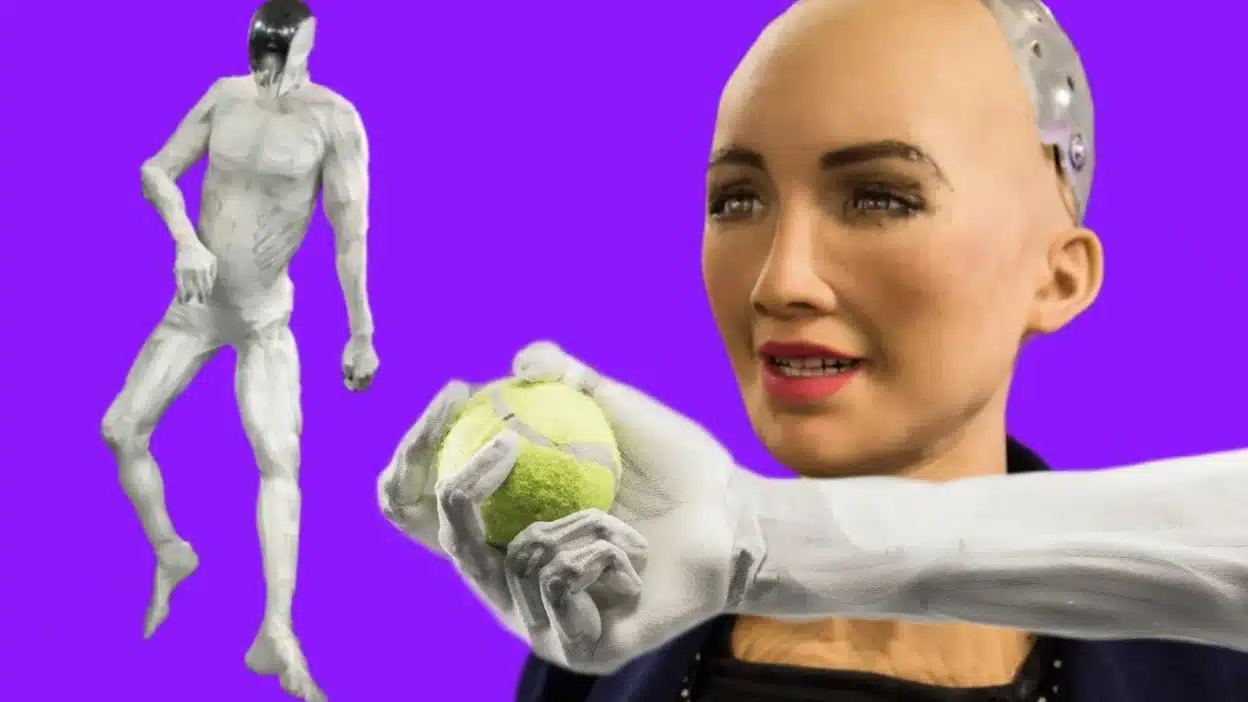
- The Glitch: Many robots have eyes that feel fixed or “painted on.” If a robot stares at you without those tiny shimmies, or if its blink feels like a mechanical rather than fluid motion, your brain will instantly flag it as uncanny. Sophia the robot from Hanson Robotics is a good example of this. She was designed to be expressive and relatable, but her eyes can sometimes feel off.
2. Facial expressions that don’t match the moment
When a human smiles, the eyes and the mouth move almost simultaneously. It’s a full-face experience. We expect faces to communicate feelings, not just motion.
- The Glitch: In robots, these movements are often programmed as separate tasks. You might see the mouth curve upward, but the eyes stay the same, or the smile happens a fraction of a second after the robot speaks.
3. Movements that seem just slightly wrong
Humans have weight, gravity, and momentum. When we move our arms, our shoulders and torsos adjust to balance the weight.
- The Glitch: Many robots move with “perfect” mathematical precision. Their arms might move, but their bodies stay eerily still.
Why Do Our Brains React This Way?

There’s a reason this uncanny reaction feels so immediate.
Our brains are wired to recognize human faces, movements, and behavior incredibly quickly. It’s one of the most important things we do as social beings. We’re constantly figuring out who someone is, what they’re feeling, and whether we can trust them.
So when something looks human but doesn’t behave quite right, it creates a mental mismatch.
Part of what’s happening is that our brains like clear categories: human or machine, alive or not. But when something sits right in between, like a highly realistic robot, it becomes harder to know how to process it. That uncertainty alone can feel uncomfortable.
There may also be an evolutionary reason for this. Some researchers believe the reaction is tied to self-protection — our instinct to notice when something looks unnatural or unwell. Long before robots existed, picking up on little abnormalities in faces or movement could help us avoid danger.
So when a robot has slightly unnatural skin, stiff expressions, or unusual timing, it may stir up that same instinct, even if we know logically there’s no real threat.
In other words, your brain is doing what it’s supposed to do. It’s noticing that something looks human on the surface, but doesn’t fully feel human underneath.
What This Means for the Future of Human-Like Robots

As robots move out of labs and into our daily lives, designers are taking two very different paths to handle the creep factor.
1. The “Power Through” Approach
Companies like Clone Robotics are doubling down on realism. They believe the only way out of the uncanny valley is to go all the way through it. Basically, perfecting every micro-expression and synthetic muscle until the robot is indistinguishable from a human. It’s a high-risk, high-reward strategy that aims for total immersion.
2. The “Friendly Machine” Approach
Other companies are taking a “less is more” shortcut. A great example is 1X Technologies’ NEO, one of the latest humanoids for sale designed specifically for home use. Instead of trying to mimic human skin, NEO wears a soft, one-piece body suit and has a face that consists only of two expressive LED eyes.
By keeping the face stylized and clearly robotic, 1X is trying to skip the uncanny valley entirely. They’re betting that you’ll feel much more comfortable having a helpful droid in your kitchen than a “synthetic person” who might blink at the wrong time.
Why Do Robots Feel Creepy: The Human Verdict
Whether a company tries to mimic us or stay clearly mechanical, the goal is the same: to earn our trust.
At the end of the day, that shiver you feel around a robot doesn’t mean that you’re behind the times or scared of robots. It’s a sign that your human instincts are working exactly as they should.
As Aram and I keep watching this tech evolve, we’re realizing that how a robot makes us feel in those first few seconds is just as important as how many dishes it can wash.
FAQ
Is the “uncanny valley” the only reason robots feel creepy?
Mostly, yes. It’s the scientific term for that “dip” in our comfort levels when a robot looks almost human. However, it’s also about trust. If a robot looks like a person, we subconsciously expect it to have a soul or empathy. When we realize it doesn’t, that mismatch feels like a trick.
Why do some robots, like the Tesla Optimus or Figure, have a blank visor instead of a face?
It’s a strategic design choice to bypass the uncanny feeling altogether. By giving the Optimus or Figure humanoid a smooth, dark visor rather than attempting human features, the designers are leaning into the fact that it’s a machine. This industrial look can be less unsettling than a robot that tries to look human, making it easier for people to work alongside them without feeling “watched.”
Can a robot’s eyes actually look real?
Technically, yes, but it’s incredibly hard. To look real, a robot needs “wetness” (specular highlights) and tiny, involuntary shimmies called saccades. Many home robots, like the 1X NEO, skip this entirely and use digital eyes because trying to replicate human eyes is still too expensive and difficult to get right.
Do all humanoid robots have that “off” feeling?
Not necessarily. Robots that are stylized — like those that look more like a “Power Ranger” or a Pixar character — usually feel friendly. The weird feeling only happens when a robot tries to look or act like a human and fails.
Want to see how this theory actually looks on a graph? Check out our full guide to the uncanny valley for the deep dive on the science and history.