Summary: Teleoperation in robotics is the remote control of a robot by a human operator, typically in real time. Instead of acting independently, the robot follows human input through cameras and sensors. Many humanoid robots still rely on teleoperation more than the public realizes, and it can make robots more useful in dangerous, distant, or highly complex scenarios.
Key Takeaways:
- Teleoperation keeps a human in control while the robot acts at a distance
- Many “autonomous” robots still rely on human support
- Teleoperation may remain a long-term part of how robots operate in the real world
When you watch a robot perform a complex task like warehouse sorting, surgery, or even loading a dishwasher, it’s easy to assume it’s fully autonomous (able to operate on its own).
But many robots aren’t operating alone.
Behind the scenes, a human may be guiding its movements in real time, watching through cameras, adjusting controls, and stepping in when things get complicated. That process is called teleoperation.
Teleoperation sits in the middle ground between manual control and artificial intelligence. It lets humans guide robots from a distance when being onsite is impractical, unsafe, more expensive, or just not necessary.
Now in 2026, as more companies race to release “autonomous” machines, teleoperation is playing a bigger role than most of us realize.
In fact, some of the most impressive clips you’ve seen, especially humanoids doing household chores, often involve more behind-the-scenes human support than you’d guess at first glance.
What Is Teleoperation in Robotics?

Teleoperation in robotics is the remote control of a robot by a human operator, usually in real time.
The word breaks down simply:
“Tele” means “at a distance.”
“Operation” means control or manipulation.
In practice, teleoperation involves three core elements:
- A human operator
- A communication link (such as Wi-Fi, fiber, 5G, or satellite)
- A robot that executes the human’s commands
The operator sends instructions, and the robot sends back feedback through cameras, sensors, or other data streams. This two-way exchange creates a live control loop.
The important distinction is that the human is still making the decisions.
That’s what separates teleoperation from full autonomy. An autonomous robot can interpret its environment and choose actions independently. A teleoperated robot acts as an extension of what a person is having it do.
In many real-world situations, it isn’t all or nothing. Some robots blend autonomy with teleoperation, allowing AI to handle routine actions while a human steps in when needed.
But at its core, teleoperation keeps a person in the driver’s seat.
Is Teleoperation the Same as Remote Control?

Not exactly.
Teleoperation is a form of remote control, but it usually involves a lot more feedback, precision, and real-time adjustment.
Basic remote control systems, like a TV remote or toy car, send simple one-way commands. You press a button, and the device responds. That’s basically it. You’re not getting much information back beyond what you can see with your own eyes.
Teleoperation, on the other hand, is more like a live back-and-forth.
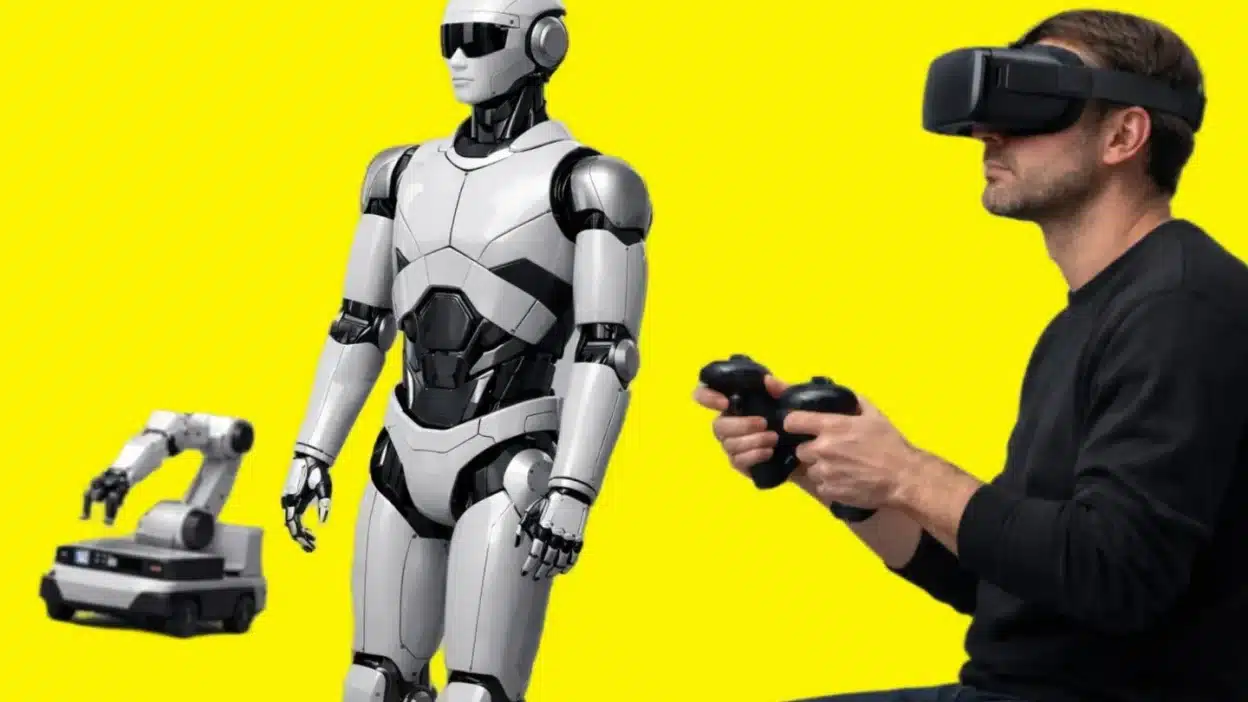
The operator sends movement commands to the robot while watching what the robot sees (usually through cameras) and monitoring what the robot “feels” through its sensors. In some setups, the operator can even feel resistance or pressure through the controls, like the robot is pushing against something.
That constant send-and-respond loop is what makes teleoperation feel more hands-on than regular remote control. It lets the operator make small corrections right away, instead of guessing and hoping the robot ends up in the right place.
In more advanced systems, operators may use:
- Control consoles or joysticks
- VR headsets
- Motion-capture rigs
- Haptic devices that simulate touch or resistance
The goal isn’t just to control the robot. It’s to make the operator feel like they’re part of the robot’s environment.
So while remote control sends simple commands from a distance, teleoperation allows a human to actively guide and adjust a robot in real time.
How Does Teleoperation Work?

At a basic level, teleoperation works through three parts: the operator, the communication link, and the robot.
1. The Operator
Everything starts with a human.
The operator may sit at a control station with screens, joysticks, pedals, or specialized controllers. In more advanced setups, they might wear a VR headset or use motion-tracking gloves that mirror their hand movements.
Whatever the setup, the idea is the same: the human sends movement instructions to the robot.
2. The Communication Link
Those instructions have to travel from the operator to the robot.
That connection might run over Wi-Fi, fiber internet, 5G networks, or satellite. Connection quality is important because even small delays can make a robot feel clumsy to control.
This delay is known as latency. If the robot reacts half a second after a command is sent, precise movements become much harder.
3. The Feedback Loop
At the same time the operator is sending commands, the robot is sending information back.
This usually includes live video feeds, but it can also include data from sensors that detect pressure, position, or contact with objects.
That back-and-forth exchange allows the operator to adjust in real time. If something slips, shifts, or doesn’t move as expected, the human can correct it immediately.
In simple terms, teleoperation works because the robot becomes the body, and the human remains the brain.
Where Is Teleoperation Used?

Teleoperation is most useful in situations where sending a human would be dangerous, expensive, or physically impossible. Here are some of the most common real-world uses.
Robotic Surgery
One of the best-known examples is the Da Vinci Surgical System where the surgeon doesn’t stand directly over the patient. Instead, they sit at a console and control robotic arms using hand and foot controls while watching a magnified 3D view.
The robot translates the surgeon’s movements into more precise motions, but the surgeon remains fully in control. The robot does not decide what to cut or stitch.
Space Exploration
Space agencies like NASA regularly rely on teleoperation to work in environments that humans can’t reach safely.
Rovers on Mars, for example, are controlled from Earth. Because of communication delays between planets, commands are often sent in batches, but humans still plan and guide the robot’s actions carefully.
Astronauts aboard the International Space Station also use teleoperated robotic arms to move equipment and assist with other tasks.
Disaster Response and Hazardous Environments
Teleoperated robots are widely used in bomb disposal, nuclear plant inspections, underwater exploration, and firefighting.
Instead of putting a person in danger, operators control robots from a protected location. Cameras and sensors allow them to see what’s happening without being physically there because sometimes robots can do things humans cannot (or should not).
Warehouses and Industrial Settings
In industrial environments, teleoperation is often used when robots encounter situations that autonomy alone can’t handle.
A warehouse robot may move boxes independently most of the time. But if something falls, jams, or moves unexpectedly, a human operator can step in remotely to guide it through the problem.
Teleoperation vs. Autonomous Robots: What’s the Difference?
An autonomous robot is designed to operate on its own.
It uses sensors, software, and artificial intelligence to interpret its surroundings and decide what to do next without direct human control.
A teleoperated robot, by contrast, relies on a human operator to guide its actions in real time. Some delivery robots are teleoperated.
The difference comes down to decision-making.
- In autonomy, the robot makes decisions.
- In teleoperation, a human makes decisions.
- In many real-world systems, they work together.
That last part is important. In 2026, most advanced robots are not purely autonomous or purely teleoperated. They often use a hybrid model.
For example:
- A warehouse robot might navigate on its own most of the day.
- If it encounters something unexpected, a remote operator can step in.
- Once the issue is resolved, the robot returns to autonomous mode.
This approach is sometimes called teleassist or human-in-the-loop (HITL) control.
A Real-World Example: Humanoids in the Home

This is also where things can get confusing for many of us.
A robot may be marketed as “autonomous,” but still rely on remote human support behind the scenes.
For example, even some of the headline-grabbing humanoid robots being promoted for the home, like NEO and Figure, may use human teleoperation or other human-in-the-loop support to get through many tasks.
Although that can seem misleading, it doesn’t mean the technology is fake. It means real-world autonomy is still a work in progress.
Why Is Teleoperation Growing in 2026?
As more companies push robots into warehouses, streets, hospitals, and even homes, they’re running into a simple fact: the real world is messy and there are some things humans can do that robots can’t.
Objects aren’t the same. Lighting changes. Floors aren’t perfectly level. Pets and kids are unpredictable. Wi-Fi drops. Someone rearranges the furniture.
Robotic autonomy struggles in moments that don’t match the training data, so that’s where teleoperation helps.
Instead of waiting until a robot can handle 100% of scenarios on its own, companies can release robots earlier and allow humans to step in when needed. This makes systems more usable today, even if full independence is still evolving.
There’s another reason teleoperation is rising: it helps robots learn faster.
When humans remotely guide a robot through real chores, the robot can capture what it saw and did, and companies can use that to improve the AI over time.
In an interview with The Wall Street Journal, Bernt Børnich, CEO of 1X Technologies (the maker of NEO), has been quite open about it. Buyers have to be comfortable with a remote human operator occasionally seeing through the robot’s cameras in order to help it learn in real homes. As he put it, “If we don’t have your data, we can’t make the product better.”
Basically, early buyers aren’t just purchasing a robot — they’re helping train one.
What Are the Limitations of Teleoperation?
For all its benefits, teleoperation has real constraints.
One of the biggest is manpower.
If you need a human to supervise or directly control one robot, costs can add up quickly. Companies need trained operators, reliable internet connections, and the ability to manage shifts. That makes it harder to deploy large numbers of robots efficiently.
Latency is another challenge.
Even small delays between a command and a robot’s response can make tasks harder, which is crucial in fast-moving or delicate situations.
There’s also the issue of privacy and security.
If a robot is streaming video and sensor data back to a remote operator, that raises questions about who can see what, how long data is stored, and how it’s protected. As robots move into homes and workplaces, those concerns become more personal. It’s also one reason some people hesitate to trust robots in the first place.
Finally, teleoperation can be mentally demanding for the people controlling the machine.
Guiding a robot through complex physical tasks requires sustained attention. Over time, that can lead to fatigue, which affects performance.
For these reasons, most robotics companies don’t view teleoperation as the end goal. But it’s a way to make robots useful while autonomy continues to improve.
Is Teleoperation Temporary or the Future?
Teleoperation is often described as a stepping stone toward full autonomy.
It allows humans to help robots through the hard parts now while AI systems continue to improve. Over time, the robot needs less assistance.
That may be true in some cases.
But it’s also possible that teleoperation doesn’t totally disappear.
In many industries, a hybrid model makes practical sense. Robots can handle routine tasks independently while humans remain available for edge cases, oversight, and decision-making. That combination can be safer, more flexible, and more accountable than autonomy alone.
In homes especially, where things are unpredictable and deeply personal, full independence may not be the only goal. Reliability, transparency, and human supervision may matter just as much.
So teleoperation might not just be a temporary phase. Maybe it’ll be a permanent part of how real-world robots operate. And that might actually make some of us feel more comfortable in our Robot Readiness journey.
FAQ
What is teleoperation in robotics?
Teleoperation in robotics is the remote control of a robot by a human operator, usually in real time. The operator sends commands to the robot while receiving live feedback through cameras and sensors. Unlike full autonomy (independence), teleoperation keeps a person directly involved in decision-making.
Is teleoperation the same as remote control?
Not exactly. Teleoperation is a more advanced form of remote control. It involves continuous two-way communication, allowing the operator to see what the robot sees and adjust movements in real time. Basic remote control sends simple one-way commands.
Are autonomous robots secretly teleoperated?
Some robots marketed as “autonomous” still use human-in-the-loop support in certain situations. This doesn’t mean the technology isn’t real. It means full independence is still evolving, and teleoperation is often used as a backup when robots encounter unpredictable scenarios.