
Summary: What can robots do that humans cannot do? From working in extreme environments to performing ultra-precise movements and processing massive datasets, robots can operate well beyond human limit — especially in hazardous conditions, highly repetitive workflows, and tasks requiring microscopic accuracy.
Key Takeaways:
- Robots can operate in environments that are too dangerous or physically impossible for humans, such as deep space or hazardous worksites
- In controlled settings, automated machines can perform precise, consistent tasks far beyond normal human physical limits
- While robots process large amounts of information instantly, humans still lead in judgment, creativity, and adaptability
When people ask what robots can do that humans cannot, the answers are usually pretty surface-level: they don’t get tired, they can work faster, they can repeat tasks.
While those are all true, they’re also kind of obvious.
The more interesting question is where robots actually go beyond human limits.
Not just doing things better, but doing things we physically can’t do at all. Stuff like operating in extreme environments, performing ultra-precise movements, or processing information at a level no person could match.
Here, we’re focusing on those specific categories where robots aren’t just helpful, but also genuinely superhuman in real-world ways.
Because once we look at it that way, we’ll get a better understanding of where they truly extend what’s possible.
4 Key Things Robots Can Do That Humans Cannot
When we zoom in on what robots can actually do beyond human limits, a few specific capabilities stand out.
These aren’t just cases where robots are faster or more efficient. They’re situations where machines can operate in ways that simply aren’t possible for the human body or mind.
Here are some of the clearest examples.
1. Work In Environments Humans Cannot Survive
One of the clearest examples of robots doing something that humans can’t is to operate in places that would seriously injure us, kill us, or simply make no practical sense for a person to enter in the first place.
Space is the obvious example. That’s a big reason we send robots into space before, instead of, or alongside humans.
As 20-year roboticist Coleman Benson said in our interview:
“Robotics will still be the best way to explore beyond our planet and solar system. Current robots don’t need oxygen or food, can use renewable energy for endless power, and will become increasingly more sophisticated and last longer without human intervention.”
That same logic applies here on Earth. Robots are often used for hazardous work like handling dangerous materials, operating in unstable environments, or taking on tasks that would expose people to long-term risk.
You see this in nuclear cleanup, bomb diffusion, deep-sea exploration, and disaster response, where sending a machine instead of a person is much safer.
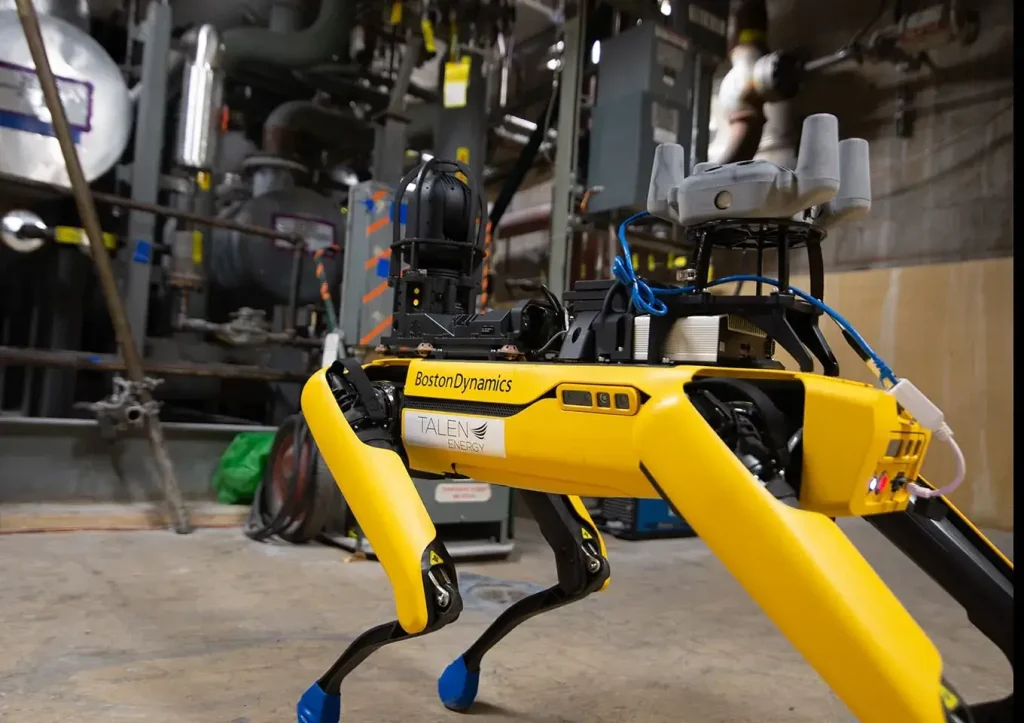
For example, Boston Dynamic’s robotic quadruped Spot is being used in nuclear power plants to conduct visual and thermal inspections as well as perform radiation surveys.
2. Perform Ultra-Precise Movements

Another thing robots can do that people cannot is perform certain movements with a level of precision, steadiness, and repeatability that goes beyond normal human ability.
This matters most in situations where even a tiny mistake can have big consequences. In manufacturing, robots can place microscopic components, make highly consistent welds, and repeat the exact same motion over and over with minimal variation.
You also see this in teleoperation, where a surgeon controls robotic arms from a console rather than standing directly over the patient. The robot doesn’t make decisions on its own, but it can translate the surgeon’s hand movements into smaller, more precise motions in tight spaces.
That doesn’t mean robots are magically better at every delicate task. But in narrow environments where accuracy, stability, and consistency matter most, they can operate at a level people simply cannot match on their own.
3. Repeat Tasks With Consistent Accuracy

Repetition is often mentioned when people talk about robots, but the real difference isn’t just that they can keep going. It’s that they can repeat the same action over and over with a level of consistency that humans can’t.
Even highly trained people who are great at their job have to deal with fatigue, distraction, and natural physical limitations. All these tiny inconsistencies can add up, especially in precision work.
Robots don’t have that problem. Once programmed or trained, they can carry out the same motion thousands or even millions of times with accuracy.
This is why they’re so widely used in assembly lines, packaging, and quality control where consistency matters just as much as speed.
4. Detect Things Humans Cannot Sense
Another way robots go beyond human limits is through sensing.
People rely on sight, sound, touch, and other biological senses. But robots can be equipped with specialized sensors that detect things we can’t perceive at all.
That includes things like thermal imaging to see heat differences, sensors that detect invisible gas leaks, or systems that can map environments using lasers.
In some cases, robots can also pick up patterns or signals — like tiny vibrations or changes in pressure — that would be impossible for a person to notice in real time.
These capabilities are especially useful in areas like industrial safety, environmental monitoring, and search and rescue, where detecting something early can make a critical difference.
As ANYbotics’ Kateryna Portmann shared in our interview, robots “don’t get tired, they don’t breathe toxic gases, and they can detect dangers humans can’t see.”
What Humans Can Still Do Better Than Robots
Even with these impressive robotic capabilities, humans still have the advantage when it comes to the messy parts of life.
We’re better at navigating unpredictable situations, understanding subtle context, and making judgment calls when there isn’t a rulebook to follow.
A robot excels in narrow, structured environments. But outside of those conditions, human flexibility and intuition still reign supreme. (Just try asking a robot to babysit a toddler and a puppy at the same time!)
FAQ
What tasks are humans still better at than robots?
While robots excel at logic and repetition, humans still lead in areas requiring emotional intelligence, complex ethical decision-making, and “common sense” adaptability. Tasks like creative problem-solving and deep interpersonal connection remain uniquely human.
Are robots always more accurate than people?
In controlled settings, like assembly lines or digital data processing, robots are significantly more accurate because they don’t suffer from fatigue. However, in unstructured environments (like a busy kitchen or a disaster site), human intuition and physical dexterity usually outperform current robotic sensors.
What are the advantages of using robots in hazardous environments?
The primary advantage is safety. Robots can withstand extreme temperatures, radiation, and toxic gasses that would be deadly to a person. This makes them essential for deep-sea exploration, nuclear maintenance, and space missions.
Can robots “sense” things that humans can’t?
Yes. One of the biggest advantages of modern robotics is the ability to use sensors for infrared vision, ultrasonic hearing, and chemical detection. They can “see” heat leaks behind walls or “hear” microscopic structural cracks that are invisible to human senses.
Robots Can Extend Human Capabilities
Robots aren’t better than humans across the board. But when it comes to operating in extreme environments, performing highly precise movements, or processing large amounts of information, they can do things we simply can’t.
Rather than being replacements for people, robots can extend what humans are capable of, hopefully making things easier and safer for us.
If you’re especially interested in human-shaped machines, take a look at our deep dive on the advantages and disadvantages of humanoid robots.