

Summary: The robot hands dexterity challenge is holding humanoids back. Learn why strength, touch, and AI make human-like hands so hard to build, and how companies like Figure and Clone Robotics are trying to close the gap.
Key Takeaways:
- The robot hands dexterity challenge is one of the biggest barriers keeping humanoid robots from being truly helpful in our homes
- Building hands that can grasp, feel, and adjust like involves replicating human touch, feedback, and learning
- Breakthroughs in soft robotics, AI training, and tactile sensing are helping robots learn to handle fragile or unpredictable objects safely
Updated: January 12, 2026
Robots need a hand. Literally.
In robotics, giving machines a hand as skilled as a human’s hand has proven very difficult — especially humanoid robot hands, which must look, move, and feel human while remaining safe and reliable.
It’s one of the biggest things holding them back from moving into our homes and becoming truly useful companions.
Think of all the things you can do with your hand without even thinking: tie your shoelaces, crack an egg without crushing it, or button up a shirt. Human hands have incredible dexterity, meaning they can grasp, manipulate, and handle objects of all shapes and sizes.
Personally, I have bad dexterity in my left hand. My right hand’s better, but I’m no guitar virtuoso. If I had a dollar for every time I asked Mar to button up my shirt, I wouldn’t be rich, but I’d be comfortable.
Even though I’m no robot expert or engineer, I am a big robot enthusiast and can’t wait to have a humanoid helping us around the house.
That’s why I’m eager to know what it’s going to take to overcome the robot hands dexterity problem.
Why Humanoid Robot Hands Are So Hard to Build
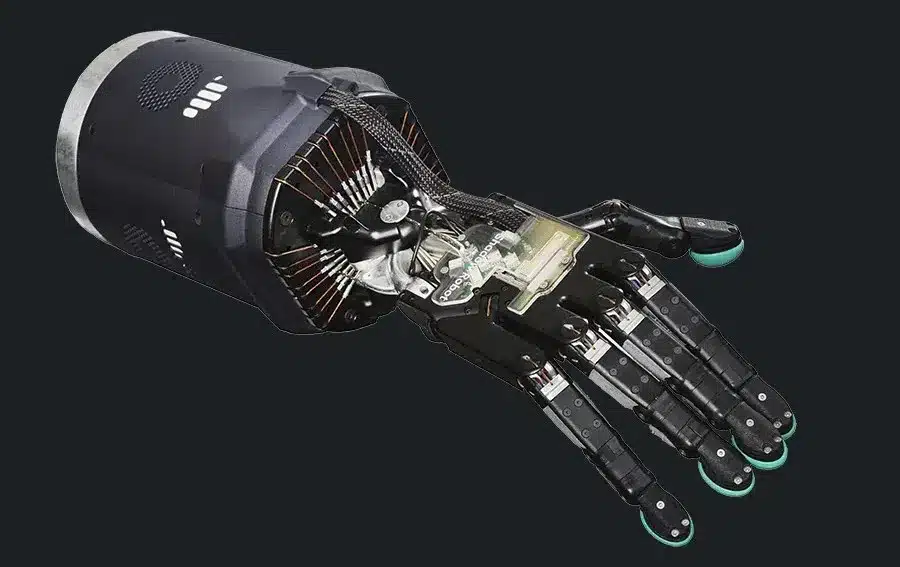
Humanoid robots face a unique problem when it comes to hands: they can’t take shortcuts. Unlike factory robots, which often use grippers or suction cups, humanoid robot hands are expected to look human and behave safely around people.
That means five fingers, fine motor control, and the ability to handle fragile, unpredictable objects without crushing or dropping them.
On top of that, humanoid robots are designed to operate in spaces built for human hands — kitchens, closets, tool drawers, dishwashers. A gripper that works perfectly on an assembly line doesn’t work well when you’re trying to button a shirt or load a dishwasher without breaking a glass.
This is why humanoid robots lag behind other types of robots in everyday usefulness. It’s not that engineers don’t know how to make robots strong or precise. It’s that building hands that can grasp, feel, adjust, and learn like ours turns out to be one of the hardest challenges in robotics.
In fact, it’s been that way since the birth of modern robotics.
What Are the Main Challenges for Humanoid Robot Hands?

Building robots with hands that actually work like ours sounds simple … until you try it. The problem isn’t just one thing; it’s a whole list of tiny, complicated details that add up fast.
Here’s what roboticists are still struggling to perfect:
Force control – using just the right squeeze, like holding a delicate object without breaking it or gripping a backpack strap tightly enough so it doesn’t slip. Remember that John Steinbeck book “Of Mice and Men” that you had to read back in high school? The big guy Lennie loved the rabbit, but he squeezed too hard. Robots face a similar problem: too much force, and things break.
Speed – moving fast or slow when needed. Quickly catching a falling ball, but moving slowly to stack tiny blocks or thread a needle.
Reliability – doing it right again and again. Not just zipping one zipper once, but zipping lots of zippers without messing up.
Generalization – handling new things, not just the one you practiced. If you can tie your shoelaces, can you also tie a bow on a gift?
Sensor feedback – using your senses to adjust. Your skin feels if something’s slippery or sharp, and your eyes see if your fingers are in the right spot. Robots need “senses” too (cameras, touch sensors, and pressure detectors) so they can change their grip the way you do.
Why Is It So Hard to Build Robots With Hands?

Some people might think building dexterous robot hands isn’t much more than just bolting metal fingers on a robot and calling it a day.
But making a mechanical hand that works like ours isn’t one problem. It’s five. And every single one of them is a pain in the … wrist.
Before today’s humanoids, most progress in robotic hands came from labs pushing the limits of dexterity.
NASA’s Robonaut 2, a humanoid robot developed for use on the International Space Station, showed that robot hands could twist valves and hold tools in zero gravity.
Meanwhile, London’s Shadow Robot Company built one of the most dexterous robotic hands ever created — a research platform capable of playing Jenga and even solving a Rubik’s Cube.
Together, these projects proved robots could mimic human hand motion in highly controlled environments, but not yet in the unpredictable conditions of everyday life.
The Physical Challenges of Robot Hands
For humanoid robots built to live in our homes, strength and motion are surprisingly tricky to balance. Most robot hands are too strong for delicate chores because they lack fine force control.
Then there’s the “muscle” problem. Humans keep our hand muscles in the forearm, pulling tendons like tiny ropes. Robots use motors that are heavy, hot, and clunky.
Imagine 20 lawnmower engines inside your arm. To lighten the load, builders move motors into the torso and run cables through the wrist, but those cables stretch and snap. It’s like having shoelaces for bones.
Even when the mechanics work, durability is still an issue. Delicate parts break easily, and the best humanoid hands can cost as much as a luxury car.
That’s why many service robots still use simple grippers or suction cups. They may not look human, but they don’t fall apart after a week.
The Sensory and Learning Challenges
Humanoid robots also struggle with something we take for granted: touch and instinct. Your hands have more than 17,000 sensors that feel texture, temperature, and pressure changes instantly.
Robots mostly rely on cameras, so it’s like they’re wearing oven mitts all day. Researchers are adding “robot skin” (pads filled with tactile sensors and fingertip cameras), but it’s still early days.
One of the newest examples is Figure 03, the third-generation humanoid robot from Figure AI, a company building general-purpose humanoid robots.
The robot’s redesigned hands have soft, adaptive fingertips and palm cameras that can see what they’re grasping, even in tight spaces like cabinets or drawers.
The company claims that each fingertip can detect forces as light as a paperclip, giving it the ability to sense when an object is about to slip before it does.
It’s impressive progress, but it also shows how far robots still have to go. Even the most advanced humanoids are just beginning to feel their way through the world.
Another company taking a different approach is Clone Robotics, which is designing synthetic humanoid robot hands that mimic human anatomy, muscles, and tendons rather than relying on traditional motors and joints.
Their “Clone Hand” uses flexible, muscle-like actuators that expand and contract like real tendons, letting each finger move with lifelike precision. Wrapped in artificial muscle fibers, the result looks and moves eerily human.
Clone calls it “the most biomimetic hand ever created,” built to perform any manipulation task a human can. My wife and I can’t stop looking at it in amazement even though it does make us feel a little like humanoid robots are getting too human.
Where Figure focuses on perception and control, Clone is tackling the biological side of the problem by building hands that feel human in both form and motion.
How Close Are We to Solving the Robot Hands Dexterity Challenge?
The truth is, roboticists aren’t as close as some headlines would have you believe, but we’re still closer than ever.
Humanoid robots can walk, talk, and even hold a conversation now, but using their hands like humans remains the final frontier.
The robot hands dexterity challenge isn’t just a mechanical problem; it’s a mix of biology, physics, and intelligence. Getting it right means giving robots not only strength and movement, but also touch, reflexes, and common sense.
With household humanoid robots now a reality, it’s easier to imagine a future where they can effectively and safely fold laundry, pour coffee, or lend an actual helping hand.
With every soft fingertip, smarter sensor, and AI update, we get closer to solving the world’s most human engineering puzzle: teaching robots how to use their hands.
FAQ
What is the most dexterous robotic hand?
The Shadow Dexterous Hand is often called the most dexterous robotic hand. Built by London’s Shadow Robot Company, it has 24 joints and 129 sensors, allowing delicate, human-like motion. It’s been used in research to play Jenga and even solve a Rubik’s Cube with AI training.
Will robotic hands ever match human capabilities?
Not yet, but it’s getting closer. Humanoid projects like Figure 03 and Clone Robotics are closing the gap with softer fingertips, tactile sensors, and muscle-like actuators. True human-level dexterity will take more advances in touch sensing, AI learning, and adaptive control.
How do robot hands sense touch and pressure?
Modern robot hands use “robot skin” made of flexible pads filled with tactile sensors and tiny cameras. These sensors detect force, slip, and texture, sending data to onboard AI that adjusts grip strength in real time. It’s similar to how human nerves guide our fingers.
Are humanoid robot hands available to buy?
Yes, but they’re primarily sold for research and industrial use, not home consumers. Advanced humanoid robot hands from companies like Shadow Robot or Unitree can cost tens of thousands of dollars and require expert setup.
In Summary: Why Human-Level Robot Hands Are Still So Hard to Build
Humanoid robot hands are one of the hardest engineering problems in robotics because hands demand touch, judgment, and adaptability in incredibly varied settings. While today’s humanoids can walk and talk, their hands are still learning how to safely grasp, feel, and respond to the messy unpredictability of the real world. Progress from companies like Figure and Clone Robotics shows what’s possible, but truly human-level dexterity remains the final frontier before humanoid robots can be genuinely helpful at home.


