

Summary: Home robot security involves protecting internet-connected robots from hacking, data theft, surveillance, and misuse. Common risks include hijacked cameras, ransomware, built-in tracking, and weak authentication. Simple steps like strong passwords, software updates, and network isolation can significantly reduce these threats.
Key Takeaways:
- Every connected robot is a security risk if you don’t lock it down
- Home robot security starts with passwords, updates, and common sense
- Manufacturers often collect data by default, so securing privacy is as important as protecting against hackers
Updated: January 30, 2026
A robot isn’t just a gadget that fulfills our sci-fi fantasies. It’s a treasure trove of your private data. And that makes it a tempting target for hackers, pranksters, and other bad guys wanting to track your every move.
It’s also why a lot of people don’t trust robots.
I’ve done some digging and uncovered five hack attacks that could make a home robot go rogue.
These are real-world home robot security risks already documented across consumer devices like robot vacuums, companion bots, and smart assistants.
I’ve also included simple ways to help prevent these problems from happening in the first place.
1. Spying Eyes: How Robot Cameras Can Be Hijacked
Your robot’s camera is great for pet checks or house patrols, until someone else is watching too. Hackers can exploit weak logins to livestream your private life without you even knowing.
Researchers have shown that household robots, smart devices, and even toy robots can be exploited to access cameras, microphones, and internal networks if security controls are weak.
The first step to protect your robot is choosing a strong password. Biometric logins (face recognition, voice match, fingerprint) offer extra security, though they’re still layered on top of traditional credentials.
Who Would Do This?
- Creeps and voyeurs using off-the-shelf tools scanning for devices with default or weak passwords
- Cyber criminals with more advanced hacking skills might record your private conversations and map out your living space or daily routines to target you for fraud
- Tech-savvy folks who helped you set up the robot might still have access via an app or shared login
How to Stop It
- Change all default login credentials immediately
- Put the robot on a separate guest Wi-Fi network
- Disable remote viewing unless you truly need it when away from home
2. Ransomware: When Hackers Lock Your Robot
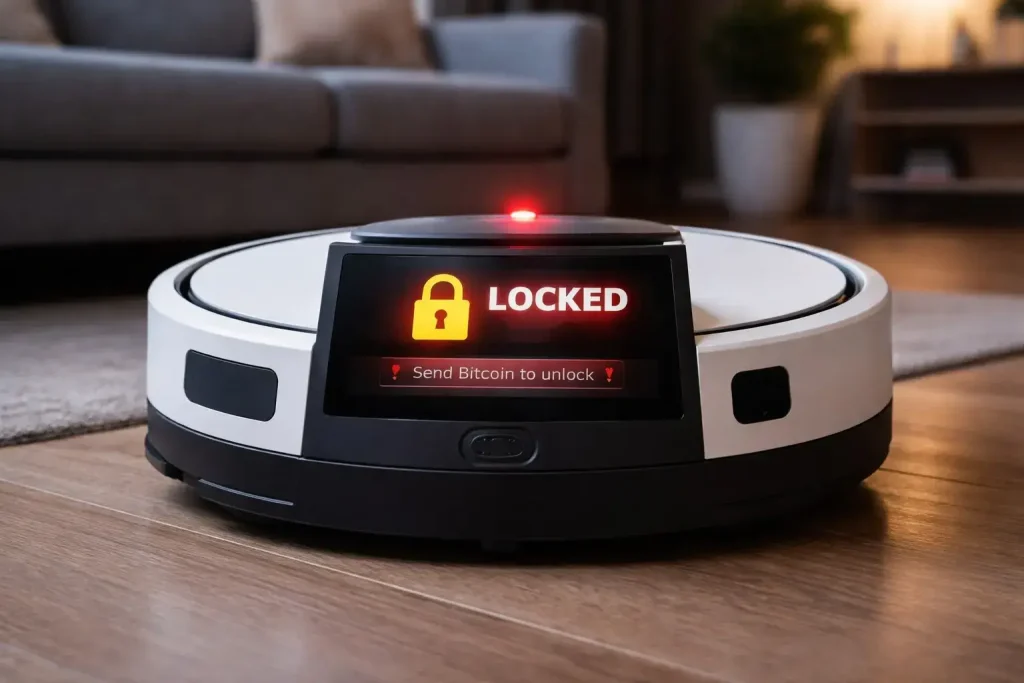
Imagine one day you approach your robot, and instead of vacuuming or waving hello, it’s flashing a message: “Send $500 in Bitcoin or I stay frozen.” This is ransomware, and it’s not just for big corporations anymore.
Home robots are expensive, connected, and under-protected. Why wouldn’t someone bad take advantage of you (or your mom) if they can get away with it?
Who Would Do This?
- Cybercriminals from God knows where, looking for easy payouts
- Teenage hackers learning as they go and not mature enough yet to worry about the reality of being sent to jail
How to Stop It
- Enable automatic security updates so holes get patched fast
- Back up your robot’s settings regularly so you can factory-reset and restore
- Choose brands that take security seriously and publish real security audits
3. Data Drain: When Robots Collect and Share Your Data

Some robots don’t need to be hacked. They arrive ready to track, retrieve, and share your data right out of the box. Maybe the companion app quietly uploads floorplans, voice snippets, or daily routines “for quality improvements.”
Fast-forward a month and you’re seeing highly targeted ads for your exact kitchen layout and you realize your robot has been spying on you. Those silent streams of metadata paint an intimate portrait of your life without you even knowing what’s going on.
Who Would Do This?
- Data-hungry companies selling “personalized experiences”
- App developers hiding code and sneaking in extra analytics
- Shady middlemen reselling metadata
How to Stop It
- Choose robots that allow local-only storage or true opt-outs
- Block suspicious domains in your router
- Actually read the privacy policy
FYI: Don’t assume your robot vacuum is harmless. Many of them quietly map your home and upload data. Case in point: Ecovacs has some serious security flaws in their robot vacuums, and the company isn’t even bothering to fix them.
4. Taken: Someone Actually Steals Your Robot
Imagine sending your robot on an errand (or even just out to the garage), and it doesn’t come back. Tech-savvy thieves can snatch it up, wipe the ID, give it a new fake serial number, and resell it overseas. Or part it out like a stolen iPhone.
Sorry, but Liam Neeson can’t save you from this one.
Who Would Do This?
- Organized tech thieves
- Anyone flipping high-end devices for cash
How to Stop It
- Activate GPS tracking or remote-lock the moment it’s unboxed
- Engrave a discreet ID or hide an AirTag under a panel
- Ask the manufacturer if they offer remote disabling for stolen units
5. Corrupted Code: Your Robot Learns the Wrong Things
Robots with machine learning can pick up commands from anyone nearby, including people who think it’s fun.
Maybe your kid teaches it to say “burp” every time someone opens the fridge. Or maybe you have a friend over who’s feeling feisty and decides to change the wake word to something embarrassing.
It might be funny for a moment, but some robots can be fed so much junk data they start malfunctioning altogether.
Who Would Do This?
- Rowdy children testing the robot’s “sense of humor”
- Party guests who’ve seen one too many prank videos
- Online trolls trying to mess with open mic channel
How to Stop It
- Keep learning modes off unless actively supervising
- Wipe training logs regularly
- Use “safe mode” settings to keep your robot’s behavior in check
Home Robot Security Starts With You
Robot hacking is a real-world concern for anyone bringing smart devices and home robots into their lives.
But with a few basic steps — like changing default passwords, running updates, setting up separate networks, and being careful about what you enable — you can stop most home robot security threats before they happen.
FAQ
Can my home robot be hacked if it’s totally offline?
If your robot has no connection to Wi-Fi, Bluetooth, or any external device, it’s extremely difficult to hack remotely. However, it could still be vulnerable to physical tampering or data extraction if someone gets hands-on access.
How do I see what data my robot is sending out?
Check the robot’s companion app or settings panel for data-sharing permissions and logs. For more visibility, monitor your network traffic or use a router with device-level tracking tools.
What are the disadvantages of having a robot at home?
Home robots can raise privacy concerns, require regular maintenance, and sometimes collect more data than users realize. They may also be costly and dependent on software updates to stay secure.
Do I need antivirus for a robot?
Most home robots don’t run traditional operating systems that support antivirus software, but they still need protection via firmware updates and strong network settings. Focus on securing your home Wi-Fi and updating your robot’s software regularly.
Are robot vacuums a security risk?
Yes—some robot vacuums map your home and may transmit data to cloud servers, depending on the brand. Always check privacy policies and consider disabling cloud features if local-only use is available.
Still curious about life with robots? Check out more from our Robot Phobic posts.