

Summary: Humanoid vs android describes two very different types of robots. Humanoids are robots built in a human-like shape to work in our world, while androids are a specific type of humanoid designed to look and behave as much like a real human as possible. This guide breaks down the differences, where cyborgs fit in, and how today’s most realistic robots blur the lines between them.
Key Takeaways:
- Humanoids are robots built in a human-like shape; androids are a type of humanoid designed to look and behave like real humans
- Cyborgs are not robots at all but biological humans with technological enhancements
- As robots become more capable and more human-like, the lines between these terms are getting blurrier, making clear definitions more important
Here at Robots Good or Bad, we talk a lot about humanoids, and with all the new releases this year, it feels like the right moment to clear up a couple of terms that keep getting mixed together. Specifically, humanoid vs android.
The confusion is understandable. As robots start looking more human-shaped — and in some cases shockingly human-like — people (and even the companies building them) are using these words interchangeably.
The part that people always mix up is that all androids are humanoids, but not all humanoids are androids. The difference comes down to how human the robot is trying to look, which is where things get messy.
One robot gets called a humanoid even though it clearly leans into android territory; another gets labeled an android simply because it was designed to look more like us than the typical two-legged machine.
So what’s the actual difference between a humanoid vs android? And where do cyborgs fit into this?
Here’s a quick, reality-based explainer to get us all on the same page — grounded in what today’s robots actually are, not what sci-fi taught us growing up.
What Is a Humanoid Robot?
A humanoid robot is any robot built to resemble the general shape and proportions of a human. That usually means it has:
- a head
- a torso
- two arms
- two legs (or at least the hardware to simulate them)
But the key is this: humanoids are not trying to look like actual human beings. They share our form, not our face.
Most of the top humanoid robots we see in the real world today fall into this category. Think:
- 1X NEO
- Figure 03
- Apptronik Apollo
- Tesla Optimus
- Unitree G1
- XPeng IRON
Even in the case of XPeng’s IRON, which looked so much like a woman that the company literally cut open its leg onstage to prove it wasn’t a person, is still unmistakably a robot with its screen-based face and mechanical parts.
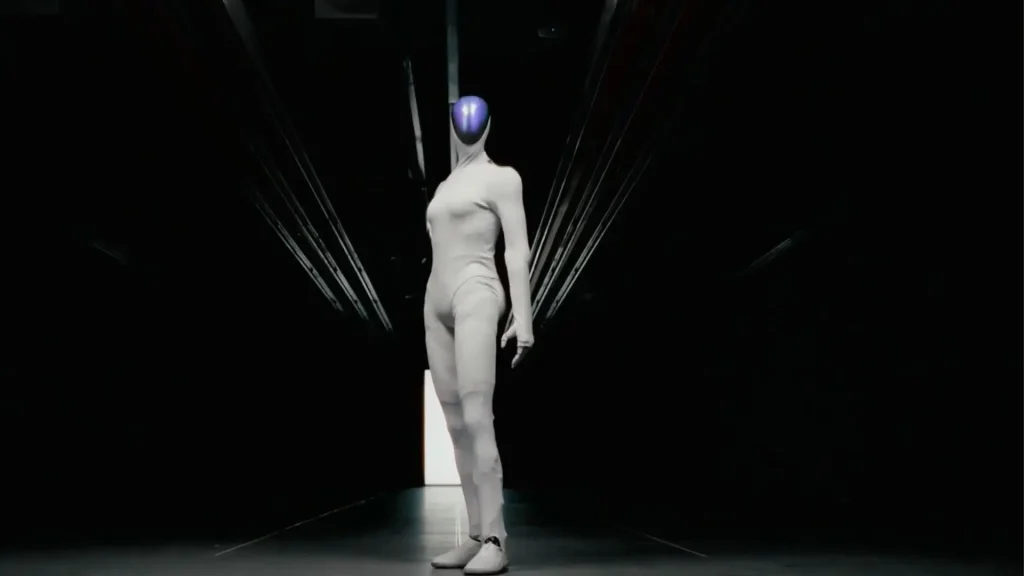
Humanoids are built to fit into human environments: doorways, hallways, vehicles, factories. They’re designed to operate in our world without requiring the world to change for them.
Their job isn’t to completely mimic us. Their job is to move like us, work where we work, and handle tasks in spaces built around the human body. This is why most major robotics companies avoid using the word android.
What Is an Android?
An android is a type of humanoid robot designed to look as human as possible — not just in overall shape, but in its appearance, face, skin, expressions, and behavior. A humanoid shares our form, but an android tries to share our presence.

Where humanoids are built for function, androids are built for human likeness. Androids typically aim for some combination of:
- realistic or synthetic skin
- human-like eyes, faces, or facial expressions
- hair, makeup, or other human-like details
- naturalistic motion or micro-movements
- emotional cues or social behaviors
With an android, the goal is to appear and sometimes even emote like a human.
Some examples of androids include:
- Clone Alpha by Clone Robotics
- Nadine Social Robot
- Ameca by Engineered Arts
- Sophia by Hanson Robotics
- Hiroshi Ishiguro’s Geminoids
- Data from Star Trek
Clone Alpha is worth calling out because it’s one of the only modern robots whose creators explicitly call it an “android.” Even though it doesn’t have a face, its synthetic skin, lifelike hands, and eerily human motion push it well beyond standard humanoid territory — and straight into the uncanny zone.
Of course, Data is a fictional character from “Star Trek,” but he set the gold standard for what an android is supposed to be: an obvious humanoid that’s designed to resemble and relate to humans, not just operate near them.
In the real world, androids are still relatively rare because they’re expensive and complicated. That’s why the term “android” is more common in research labs, entertainment, and sci-fi than in industrial robotics.
But as robots start looking more human-like, the line between humanoid vs android is getting harder for us to understand.
Humanoid vs Android: What’s the Difference?

A humanoid is a robot with a human-like body shape, while an android is a type of humanoid robot designed to look and behave as human as possible.
The key difference is appearance: humanoids can look mechanical, but androids aim for realistic human features like skin, faces, and expressions. (Although as we’ve seen, some companies don’t adhere to all those distinctions. No wonder we’re all confused!)
Here’s the key thing to remember: All androids are humanoids, but not all humanoids are androids.
It’s one of those relationships — kind of like how tequila is a type of mezcal, but not all mezcals are tequila. Same deal in robotics: embodied AI is a subset of physical AI, but not all physical AI is embodied. Once you see the hierarchy, the terms suddenly snap into place.
If you’re curious, check out our explainer on physical AI vs embodied AI.
What’s the Difference Between a Humanoid vs Android vs Cyborg?

When it comes to humanoids, androids, and cyborgs, these terms sound similar, but they describe three very different things. Here’s the simplest way to break them apart:
- Humanoid: A robot with a human-like body shape
- Android: A type of humanoid robot designed to look and behave as human as possible
- Cyborg: A human (or other living organism) enhanced with mechanical or electronic components
That’s the core distinction:
- Humanoid = human-shaped machine
- Android = human-shaped and human-looking machine
- Cyborg = human with machine parts
A cyborg is still a biological human, while humanoids and androids are straight-up machines. That’s why you’ll never hear a robotics company call its robots “cyborgs.” The term belongs to biology, medicine, and human augmentation — not robotics.
Real-world cyborg technologies today include things like advanced prosthetic limbs, bionic retinas, neural implants, and brain–computer interfaces. Sort of like when Picard was unwillingly assimilated by the Borg in “Star Trek: The Next Generation.”

And in case you’re wondering, that means most sci-fi “robots” that used to be human (like half of the Marvel universe) are technically cyborgs, not robots. Hollywood mixes the terms even more than the internet does.
Why Are People Confused About These Terms?
A big part of the confusion comes from the fact that robots are getting more human-like at the exact same time sci-fi is getting more realistic. The words we use haven’t kept up.
Most people grew up with androids, cyborgs, and humanoids all mashed together in movies, TV, books, and video games, so the vocabulary feels interchangeable even though the categories aren’t.
Sci-fi is the biggest culprit. Data from Star Trek is an android. The Terminator is a cyborg. C-3PO is a humanoid robot. But good luck finding a movie that bothers to explain any of that.
Modern robotics adds another of confusion because companies are releasing robots that look more and more realistic. So when people see a robot with “skin” or facial animations, they might assume it’s an android.
Then there’s the uncanny valley, which guarantees that the moment a robot looks a little too human, our brains stop caring about the technical definitions and jump straight to: Is that thing supposed to be a person or not?
In short: sci-fi trained us to use the words loosely, and modern robotics is making the boundaries blur in ways our language hasn’t caught up with yet.
Are Androids the Future or Just Sci-Fi?

Right now, androids sit in an odd place. They’re iconic in science fiction, instantly recognizable, and endlessly fascinating. But in the real world, they’re still a niche within a niche.
Most robotics companies aren’t trying to build robots that look exactly like humans. They’re trying to build robots that can do things humans do, and that usually means making them in the shape of humans.
Androids come with real engineering challenges:
- synthetic skin is expensive and fragile
- realistic eyes and faces are hard to animate convincingly
- expressive motion requires a huge amount of computation
- the uncanny valley can repel people rather than help them
- maintenance becomes exponentially more complicated
Laboratories build androids to study human–robot interaction, emotional expression, and social behavior.
Entertainment companies build them because audiences love them. But the companies making robots for factories, warehouses, retail, and the home are overwhelmingly focused on humanoids, not androids.
Humanoid vs Android: Why the Difference Matters
Understanding the difference between a humanoid vs android isn’t just a nerdy vocabulary lesson. It gives us a clearer sense of what robots are actually for — and how they might fit into our lives.
Humanoids are built to move through our world and do useful work, while androids aim for human likeness and social presence.
As robots get more capable, and sometimes more human-like than anyone expected, the line between the two will only get blurrier. But knowing the distinction helps us talk more clearly about what’s being built today and where the technology is really heading, and maybe even avoid a few internet arguments along the way.
In Summary: Understanding the Difference Between Android vs Humanoid
The whole debate around humanoid vs android comes down to intention. Humanoids are robots shaped like us so they can move where we move and handle the work we designed our world around. Androids take a different path, pushing toward human likeness with skin, faces, and social cues. Cyborgs, meanwhile, aren’t robots at all — they’re humans with upgrades.
As robotics keeps advancing, those boundaries will shift and blur, but the core idea stays the same: humanoids focus on capability, androids focus on appearance, and cyborgs focus on enhancing biology. Once you have that framework, the rest of the conversation gets a whole lot clearer.


